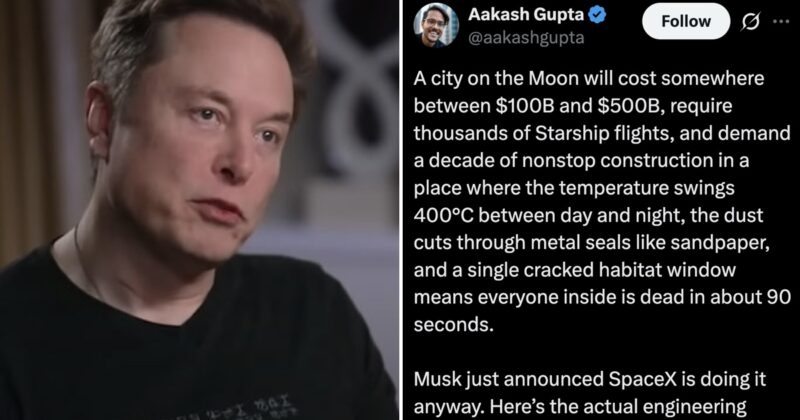
Elon Musk swapped Mars for the Moon and this forensic examination of the challenge ahead was a reality check of epic proportions
After wanging on relentlessly about how he’s going to take humanity to Mars, it turns out Elon Musk has rather reined in his ambitions and is now going to build some kind of community on the Moon instead.
Give it a couple more years and he’ll be reduced to building a conservatory.
Elon Musk’s SpaceX is delaying Mars plans to focus on an uncrewed Moon landing by March 2027
“We’re gonna go to the Moon, we’re gonna have a base on the Moon, we’re gonna send people to Mars and make life multiplanetary”pic.twitter.com/urwQdRMpbs
— SMX 🇺🇸 (@iam_smx) February 7, 2026
Anyway, back to the present, where the X man has been furiously tweeting and retweeting all things lunar.
It will be so epic so see! https://t.co/2NpljEcqSk
— Elon Musk (@elonmusk) February 9, 2026
And yet …
Anybody who believes this depiction is an absolute moron and probably failed high school science. Every single human depicted in this AI-generated image would DIE on the moon, relatively quickly. In my podcast tomorrow, I explain all the reasons why. It’s basic science and… https://t.co/PY6Fn0JkfF
— HealthRanger (@HealthRanger) February 10, 2026
And we particularly liked this tweet which went viral for reasons which will become apparent.
A city on the Moon will cost somewhere between $100B and $500B, require thousands of Starship flights, and demand a decade of nonstop construction in a place where the temperature swings 400°C between day and night, the dust cuts through metal seals like sandpaper, and a single… https://t.co/G1USJXJ0Ph
— Aakash Gupta (@aakashgupta) February 9, 2026
And here it is in full.
‘A city on the Moon will cost somewhere between $100B and $500B, require thousands of Starship flights, and demand a decade of nonstop construction in a place where the temperature swings 400°C between day and night, the dust cuts through metal seals like sandpaper, and a single cracked habitat window means everyone inside is dead in about 90 seconds.
‘Musk just announced SpaceX is doing it anyway. Here’s the actual engineering path.
‘You build at the south pole. Specifically the rims and floors of craters like Shackleton and Cabeus, where temperatures in permanent shadow drop below -230°C. NASA estimates 600 million metric tons of water ice are buried in these craters under about 40 cm of dry regolith.
‘That water becomes your oxygen supply, your drinking water, your radiation shielding, and 78% of your rocket propellant by mass. The crater rims get near-continuous sunlight for solar power. You build where the resources are.
‘Getting there is where it gets wild. Every Starship lunar mission requires 10-15 tanker flights to fill 1,200 tons of propellant in Earth orbit before the ship can even leave. One cargo delivery to the lunar surface burns through roughly 12 Starship launches. Starship V3 lands 100 metric tons per trip.
‘The Moon is 2 days away with launch windows every 10 days. Mars gets one window every 26 months with a 6-month flight. That 13x iteration advantage is why Musk pivoted.
‘The first 20-30 landings are all cargo. No humans. You’re sending solar arrays for the crater rims targeting 100+ kW continuous, nuclear fission reactors for the 14-day lunar night, ISRU rigs that mine ice from regolith and electrolyze it into hydrogen and oxygen, pressurized hab modules, and autonomous rovers that 3D-print structures from lunar soil using concentrated solar heat.
‘Each landed Starship also stays as a permanent building. 50 meters tall, 9 meters wide, 1,100 cubic meters of pressurized volume. The ISS has 916 cubic meters and took 13 years to assemble. Three Starships on the surface already exceed that.
‘The economics flip the moment you start producing oxygen on the Moon. You stop shipping 78% of your propellant from Earth. Tanker flights per mission drop from 15 to about 4.
‘Every ton produced locally frees up mass budget on the next inbound Starship for more construction equipment, food systems, and mining hardware. The base starts building the base. That’s what “self-growing” means. Compound logistics where each delivery makes the next delivery cheaper.
‘2027: first uncrewed Starship lunar landing. SpaceX told investors March 2027. 2028-2030: cargo buildup, 30-50 deliveries, all robotic, ISRU prototypes go operational. 2030-2032: first crews arrive, probably 6-12 people, 6-month rotations, running equipment maintenance and scaling propellant production.
‘2033-2035: permanent population hits 50-100, propellant depot goes up in low lunar orbit so arriving ships refuel before descent. 2035 onward: population grows past 100, agricultural modules come online, the base becomes partially self-sustaining.
‘The unsolved problems are real. Lunar dust is electrostatically charged and sharp as broken glass. It shreds seals, clogs machinery, and embeds in lung tissue. Nobody has a long-duration fix.
‘Radiation on the surface runs 200x Earth’s dose. Regolith shelters and water shielding help but add enormous construction overhead. The 14-day night drops temperatures to -173°C and kills all solar power, and the only flight-ready nuclear reactors produce 1-10 kW, far below what a growing base demands. What years of 1/6 gravity do to human bone density and cardiovascular systems is completely unknown.
‘SpaceX is valued at a trillion dollars and just told investors the Moon comes first. They’re betting that proving lunar logistics at commercial cadence builds the playbook for Mars. The Moon is a 2-day test lab with a 12-day resupply cycle. Mars is a 6-month voyage with a 2.5-year wait if anything breaks. It makes sense.’
It caught Musk’s attention, who said this in response.
Starship V4 Tanker version will deliver >200 tons of propellant per flight, so more like 5 or 6 tanker flights to refill the lunar transit Starship in orbit.
Shouldn’t be too much of a problem if we’re doing >10k flights/year.
— Elon Musk (@elonmusk) February 9, 2026
That’s a lorra lorra flights.
To conclude …
If you ever feel dumb just remember it took Elon Musk 15 years to realize the moon was a lot closer than Mars.
— Rathbone (@_rathbone) February 9, 2026
And also.
I don’t think he should be allowed to destroy the thing we all stare at every night after work while dreaming of a life without capitalists like him. https://t.co/EqI3idVZLP
— J. J. Ellis (@jjellisart) February 9, 2026
And finally.
Translation: He's fooling me again 👍
— Cuckturd (@CattardSlim) February 9, 2026
READ MORE