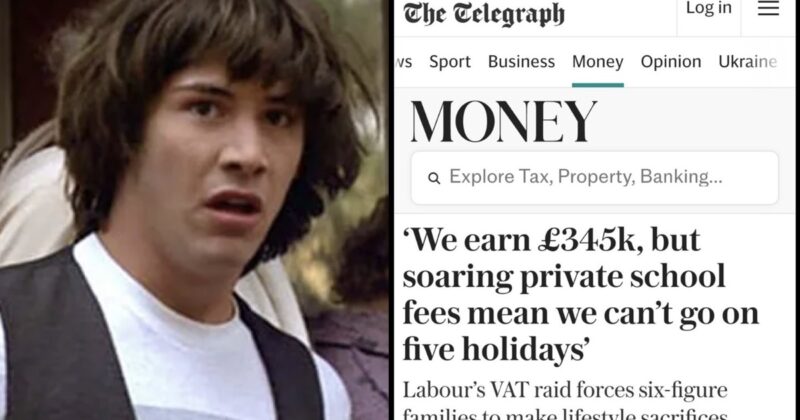
Weird World correction telegraph
The correction to this Daily Telegraph ‘private school fees’ story just gets better and better and it’s an absolute belter
19. Publications are expected to demonstrate what steps they have taken not to publish inaccurate information – this shows compliance with the Editors’ Code, and a commitment to high editorial standards.
The publication had not provided any evidence of adequate pre-publication checks, and within hours of publication it had evidently been able to establish that it could not stand by the story – leading to the decision to withdraw it. In these circumstances, the Committee found that there was a serious failure to take care not to publish inaccurate information and a breach of Clause 1 (i).
20.
Based on the limited information provided by the publication, the Committee was satisfied that the article was inaccurate on at least two points: the gardener’s pay, which the publication had attributed to a subediting error, and the presentation of stock images as images of the family featured in the story.
21.
However, given that the publication had indicated that it had lost confidence in the article as a whole and there was no evidence from any source to corroborate the existence of the family or accuracy of the information provided about their circumstances, the Committee considered that there was sufficient basis to find that the article was significantly inaccurate and required correction.
22.
The Committee therefore turned to the question of whether the apology published by the publication met the terms of Clause 1 (ii), which requires that significantly inaccurate information is corrected, promptly and with due prominence, and where appropriate, an apology published.
23.
The Committee considered the adequacy of the correction and apology published by the publication. The Committee welcomed that it included an apology, which was appropriate given the extent of the publication’s inability to stand by the story. It also contained a clear acknowledgment that the family shown in the stock images was not the family referenced in the case study.
However, the apology did not set out how the remainder of the article was inaccurate. The Committee acknowledged that, given the unusual circumstances of the case, the publication could not identify each specific inaccuracy in the article and correct it; this followed from its earlier failure to take care.
Nonetheless, the consequence was that the publication could not verify any of the remaining details in the article in a manner which would allow it to adequately correct the record in the manner required by the terms of Clause 1 (ii). Given this, and the extent of the breach, the Committee did not consider that this significantly inaccurate article could be remedied by a correction. There was, therefore, a breach of Clause 1 (ii).
24.
The complaint was upheld under Clause 1.
25.
As noted above, the Committee did not consider that the publication of a correction was sufficient or appropriate to remedy the breach of the Code in this case, given the extent and seriousness of the breach and the difficulty of clarifying to readers the correct position.
For the same reasons, it also considered that the publication of a further correction and apology was not the appropriate means to provide remedy to the breach. In such circumstances, the Committee considered that the publication of an adjudication was required to remedy the breach of Clause 1.
26.
The Committee considered the placement of this adjudication. When considering the prominence of this adjudication, the Committee noted that – notwithstanding the seriousness of the breach – the publication had quickly removed the article and had later published an apology.
It therefore considered that the adjudication should be published online as a standalone article, with a link to this adjudication (including the headline) flagged on the top 50% of the publication’s homepage for 24 hours; it should then be archived in the usual way. A link to the adjudication should also be added to the publication’s published apology.
27.
The terms of the adjudication for publication are as follows:
Ian Fraser complained to the Independent Press Standards Organisation that Telegraph.co.uk breached Clause 1 (Accuracy) of the Editors’ Code of Practice in an article headlined “We earn £345k, but soaring private school fees mean we can’t go on five holidays”, published on 25 May 2025.
The complaint was upheld, and IPSO required Telegraph.co.uk to publish this adjudication to remedy the breach of the Code.
The article – which appeared online only – reported on the impact increases in private school fees had had on a named couple and their three children.
The complainant said that the article was inaccurate in breach of Clause 1 because he did not believe the family referenced in the article existed.
While the publication accepted it had not taken due care over the accuracy of the article, it said it was satisfied any error had been rectified promptly and prominently. It said the article was “expunged” from online and from its social media as soon as the issues in question arose.
It added that it had become clear shortly after publication that there was an issue with the images, which had led to an internal investigation. It said the investigation revealed that the issues which arose stemmed from a failure to make pre-publication checks.
On 18 June, the publication published a standalone apology, in which it said it had “not been able to verify the details published”.
Given that the publication had indicated that it had lost confidence in the article as a whole, IPSO considered that, in such circumstances, there was sufficient information before it to find that the article was significantly inaccurate.
Publications are expected to demonstrate what steps they have taken not to publish inaccurate information – this shows compliance with the Editors’ Code, and a commitment to high editorial standards The publication had not provided any evidence of adequate pre-publication checks, and within hours of publication it had evidently been able to establish that it could not stand by the story.
In these circumstances, IPSO found that there was a serious failure to take care not to publish inaccurate information and a breach of Clause 1 (i). The Committee acknowledged that, given the unusual circumstances of the case, the publication could not identify each specific inaccuracy in the article and correct it; this followed from its earlier failure to take care. Nonetheless, the consequence was that the publication could not verify any of the remaining details in the article in a manner which would allow it to adequately correct the record in the manner required by the Code.
IPSO therefore did not consider that the publication of a correction was sufficient or appropriate to remedy the breach of the Code in this case, given the extent and seriousness of the breach and the difficulty of clarifying to readers the correct position. In such circumstances, IPSO required the publication of an adjudication.
Only one word to sum that up. Boom!
This is insanity wow https://t.co/1RwOOIwyiG
— liv 💛 (@oliviazao) March 3, 2026
READ MORE
Source IPSO H/T @GerryHassan