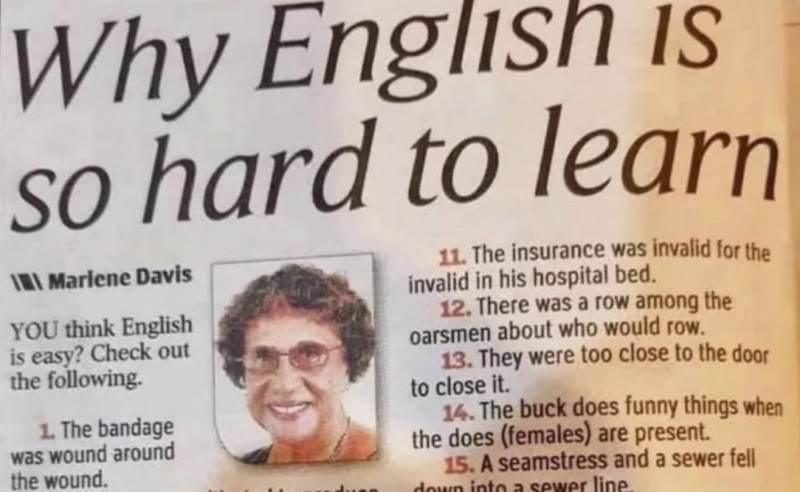
This 20-point guide why English is so hard to learn just went viral for reasons which will presumably become obvious
How hard it is to learn English? This hard, if this 20-point guide that just went viral on Twitter is any fink to go by.
It was posted by @simongerman600, who was born in Germany but now lives in Melbourne, Australia and, well, best have a read for yourself.
As a non-native English speaker I must say Marlene’s list is a great showcase of how tricky English can be at times. pic.twitter.com/anpz0u0nbu
— Simon Kuestenmacher (@simongerman600) April 19, 2026
Just in case that’s tricky to read in full …

It had plenty of people nodding their heads in agreement.
It’s such a hodge-podge of different languages – started off as Old English – the Germanic language of the Angles & Saxons that invaded Britain in small boats. Normans added about 30% French, the rest is around 30% Old English & 30% Latin. Welsh & Cornish Celtic languages survive
— Matty Cunningham @manxmatty.bsky.social (@manxmatty) April 19, 2026
True. But English has it so right with universal “a” and “the” with no gender at least.
— Mark Dixon (@markwdixon) April 19, 2026
English is not that easy !! pic.twitter.com/lPMxp0IlmL
— Anand Aggala (@aggala) April 19, 2026
My grandfather was a primary school teacher and then principal. He recounted a story of him talking to an Italian immigrant after WWII (if it is a true story?) who was asking Jim about fruit. Jim said it’s blackberry, response but it’s red, Jim that’s because it’s green (unripe)
— Margot McLennan 🌻 (@Gotwat31) April 19, 2026
Not everyone was buying it.
These are clunky constructions most native speakers would either say differently or just say the sentence without a problem.
Try Danish, the written form appears to bear no relation to the spoken form.
— Dr Peter For Dundee East💚🤍💜 🏴 🇳🇿 (@WingsEcosse) April 19, 2026
It is the simplest language to learn. It has very simple plurals tenses, no genders and is a mix of both Latin and Germanic.
— Andy Culture – Character – Attitude (@andyblueskyz) April 19, 2026
It’s not though. All languages have quirks that cause issues for beginners. English has them, with irregularities in spelling and pronunciation being one such domain. On the other hand, English doesn’t have grammatical gender, and a very simple system for subject-verb agreement. https://t.co/4H3hL3xunS
— Christine || The Other Murdock Papers (@Chris_TOMP) April 19, 2026
We’ll get back to you once we’ve mastered it.
READ MORE